
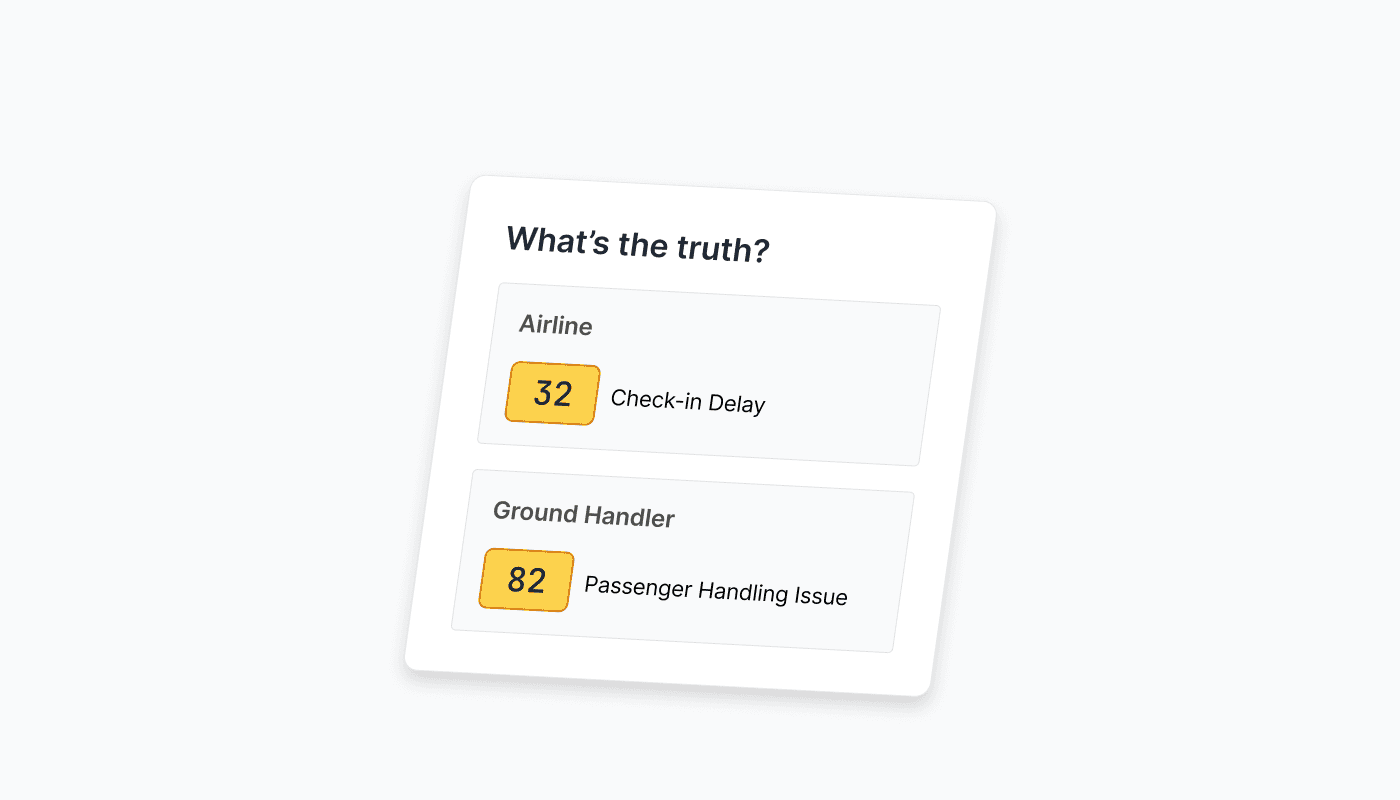
Anyone working in Ground Operations has seen this situation play out: a flight departs late, the teams wrap up the turnaround, and both sides document the reason. The airline enters 32 – Check-in Delay. The ground handler enters 82 – Passenger Handling Issue.
Two different delay codes for the same event — and both teams firmly believe they captured the truth.
This isn’t an exception. It’s the norm. And it tells us something important about how delay codes are used today.
One Delay, Two Perspectives
In this example, the airline sees passengers arriving late at the gate. Boarding starts behind schedule, so “check-in delay” feels justified. From their point of view, the critical path was broken right at the handover from the ground handler to the gate.
The ground handler sees something else: check-in closed on time, but passport control was overwhelmed. Long queues pushed passengers into the gate area much later than expected. Their reasoning is: check-in worked correctly — this was a passenger-flow issue outside their direct control.
Both sides act rationally based on what they observe. But without a shared view of the full sequence of events, these interpretations drift apart.
Why Misalignment Happens
The reasons sit deeper than the individual delay code:
Different operational lenses
Airlines see the full rotation, passenger connection times, and the broader network. Ground handlers see the station and the processes they directly manage. Each team focuses on the part of the operation they’re accountable for.
Incentives around SLA penalties
This one comes up repeatedly in our sales meetings. When a delay code can trigger contractual penalties, ground handlers become cautious. In ambiguity, many lean toward non-SLA-relevant codes. Airlines know this — which fuels mistrust and lengthy monthly debates.
Time pressure
Delay coding often happens minutes after departure. With limited code options and no shared context, teams simplify. The subtle, real root cause gets lost.
The Real Cost of Misalignment
Whether the delay came from check-in, the gate, or passport control, the operational impact is the same. Every minute of delay costs roughly 10–20× more than what an airline recovers through an SLA penalty.
Yet in most airlines today, these discussions only happen weeks later in monthly performance meetings. By then, no one remembers the exact sequence of events. Details are reconstructed from memory, delay codes become fixed narratives, and conversations focus on defending positions rather than improving processes.
Penalties shouldn’t be the ultimate goal — avoiding delays is what creates real financial value. But when teams talk about issues long after they happen, the opportunity for early correction is gone. Misunderstandings persist. Recurring delays remain unsolved.
The Shift: From “Who’s at Fault?” to “How Do We Fix It?”
The goal of delay codes is not to determine who pays — it’s to understand what happened so the teams can prevent it next time.
With a shared view of the operational timeline, the conversation changes quickly:
Was check-in really the bottleneck?
Were passengers held up in security or passport control?
Was information passed early enough between airline and handler?
Could staffing or communication processes be adjusted?
When both parties work from the same facts, the focus naturally moves to solutions rather than blame.
How Cosmos Helps Build a Shared Reality
Cosmos doesn’t invent new data — it brings the existing data into one shared view.
Both parties see the same MVT delay codes, the full turnaround timeline, and any other useful piece of information:
timestamps for boarding start and end
check-in closure
bag offload and loading
catering, cleaning, fueling
crew and aircraft readiness milestones
aircraft details
gate position
booking numbers
special requests
… and more
By putting these details side by side, Cosmos makes it easy for airlines and ground handlers to review what actually happened, minutes after departure.
Instead of debating memories weeks later, teams can walk through the event sequence together, identify where the process slowed down, and clarify whether the assigned delay code reflects the real bottleneck.
This early, fact-based conversation prevents disputes and enables both parties to focus on avoiding the next delay — not arguing about the last one.
Conclusion
Accurate delay coding isn’t about enforcing penalties. It’s about revealing the truth behind operational disruptions so airlines and ground handlers can fix problems together.
When both sides share the same reality, delays become preventable rather than inevitable — and passengers feel the difference.

